

Best Walk and Earn Apps That Actually Pay in 2026 (and the Ones to Avoid)
We compared eight walk-and-earn apps on real payout evidence, monthly earnings at 10,000 steps a day, cash-out rules and privacy. WeWard, Evidation and Paceline lead; StridePay is one to avoid.

On this page
- How we ranked these apps
- The best walk-and-earn apps in 2026 compared
- 1. WeWard: best for real cash
- 2. Evidation: best if you already wear a tracker
- 3. Paceline: best for people who actually exercise
- 4. Winwalk: best low threshold on Android
- 5. Sweatcoin: most popular, least cash
- 6. Miles: best for commuters
- 7. CashWalk: fine for Amazon gift cards, nothing more
- 8. StepBet: the only way to earn more than pocket money
- The ones to avoid: StridePay and the “$30 wall” apps
- Privacy: what you are really paying with
- Our verdict
- Frequently asked questions
Apps that pay you to walk are having another moment. App Store and Google Play charts are full of fluffy mascots promising “cash for steps”, TikTok is full of screenshots of $30 balances, and the search volume for “walk and earn app” is higher than it has been since the Sweatcoin boom. Most of those apps will never send you a cent. A handful will, if you understand that the money is small, the caps are real and the catch is almost always in the cash-out screen. This roundup ranks the walk-and-earn apps that actually pay in 2026, with realistic monthly numbers, the exact withdrawal rules, and the red flags that separate a modest reward app from a time-wasting scam.
How we ranked these apps
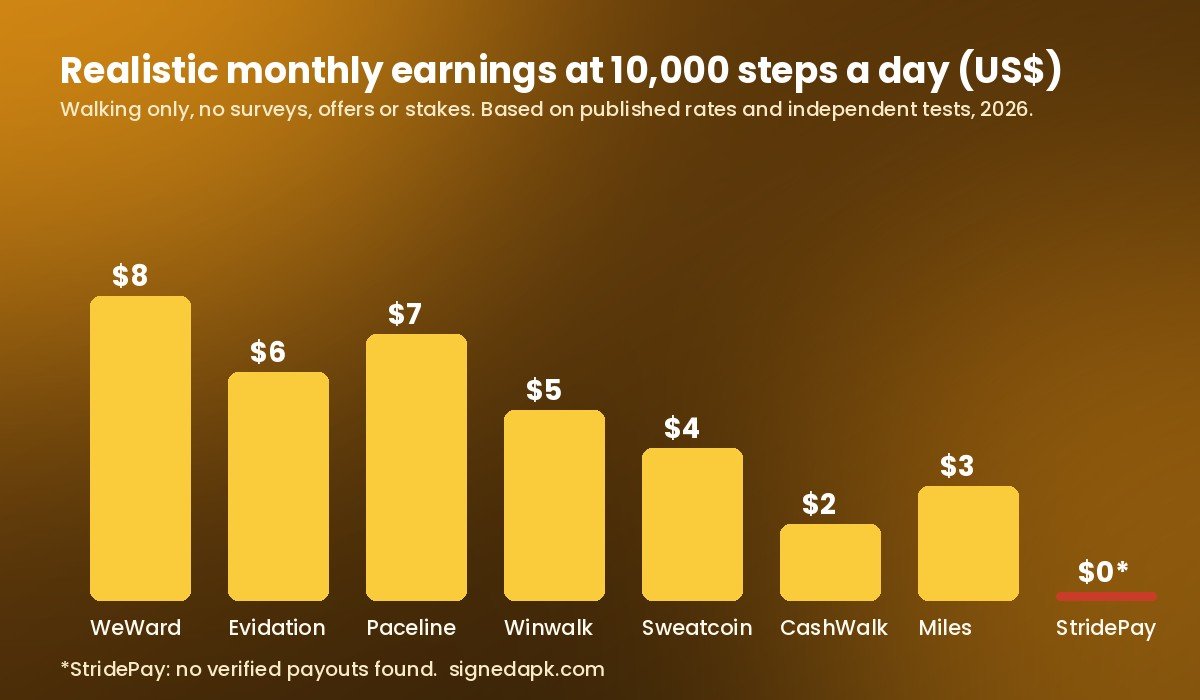
We compared each app on five things: whether there is verifiable evidence of real payouts, what a typical person walking 10,000 steps a day can realistically earn in a month from walking alone, how high the cash-out threshold is and what methods are offered, how heavily the app leans on video ads, and what the privacy label says it collects. Earnings figures come from the companies’ own published rates where they exist and from independent multi-week tests where they do not; none of the sites we drew on has a referral relationship with us, and where a test was published by a competing app we say so. Our general approach is described in how we test and score apps. All figures were checked in October 2026 and will drift, because every app on this list has cut its rates at least once.
The best walk-and-earn apps in 2026 compared
| App | Platforms | Walking-only earnings per month | Cash-out | Best for |
|---|---|---|---|---|
| WeWard | Android, iOS | $2 to $8 | PayPal, bank or Venmo; ID check; no withdrawal in first 14 days | Real cash |
| Evidation | Android, iOS | $1 to $6 (more with surveys) | $10 minimum via PayPal, direct deposit or gift cards | Health-tracker owners |
| Paceline | Android, iOS (needs a wearable) | About $7 | Gift cards and cash-back offers | People who exercise, not just walk |
| Winwalk | Android (iOS lags) | $2 to $6 | Gift cards from $1 to $5 | Low thresholds |
| Sweatcoin | Android, iOS | About $4 in marketplace value | Marketplace offers or SWEAT token; no PayPal | Discounts, not cash |
| Miles | Android, iOS | $2 to $5 | Gift cards and travel offers | Commuters |
| CashWalk | Android, iOS | $1 to $3 | Gift cards; about 5,000 coins for $5 | Amazon gift cards |
| StepBet | Android, iOS | $10 to $15 profit per six-week game, or lose your stake | PayPal at end of game | Competitive walkers |
| StridePay | iOS only | No verified payouts | $30 threshold with shifting conditions | Avoid |
1. WeWard: best for real cash
WeWard, from a French company with more than 20 million downloads, is the closest thing this category has to a reliable cash payer. Steps are converted into “Wards” in daily tiers, capped at 25 Wards a day, with a bonus for hitting a personalised goal and extra Wards for checking in at partner shops in cities. Independent tests put walking-only earnings between $2 and $8 a month at 10,000 steps a day, and WeWard pays by PayPal, bank transfer or Venmo rather than gift cards. The catches: there is no fixed Ward-to-dollar rate, so the exchange can change; you cannot withdraw in your first 14 days; identity verification is required; and payments can take up to 15 business days. It is still the one we would point most people to.
2. Evidation: best if you already wear a tracker
Evidation, formerly Achievement, is a health-research company rather than an ad network, which shows in how it pays. You earn points for walking, sleep, logging habits and short health surveys, with each activity capped at a small daily amount, and 10,000 points is worth $10 via PayPal, direct deposit or gift cards. Walking alone is slow, roughly $1 to $6 a month depending on how much data you sync, but paid research studies and surveys can pay $60 to $200 each to eligible users. Points expire after 12 months without a redemption, so set a reminder. It requires Apple Health or Google Fit data, and it is the most transparent operator on this list about what it does with your information.
3. Paceline: best for people who actually exercise
Paceline rewards 150 minutes a week of elevated heart rate rather than raw steps, so it needs an Apple Watch, Fitbit, Garmin, Oura or Whoop. In a 12-week independent test it returned about $21, or roughly $7 a month, in gift cards and cash-back offers, which is the best walking-adjacent return of any app here that does not involve betting your own money. Miss a weekly streak and you lose progress toward the bigger rewards, and the offers lean toward fitness brands and health insurers. If your walks are brisk enough to raise your heart rate, it beats every pure step counter.
4. Winwalk: best low threshold on Android
Winwalk is an Android-first pedometer that pays 10 coins per 1,000 steps up to 100 coins a day, with no GPS requirement. That caps you at about 3,000 coins a month, which independent testers converted to $2 to $6 in gift cards, with one 90-day run reaching around $14. The minimum redemption is low, $1 to $5 depending on the card, and payouts typically arrive within a few business days. The terms state that coins “have no real-world value”, which is standard legal cover but worth knowing, and the iOS version is behind the Android one.
5. Sweatcoin: most popular, least cash
Sweatcoin remains the biggest name in the category, with more than 100 million users, but it has never paid cash. You earn about 0.95 sweatcoins per 1,000 outdoor steps after the app’s 5 percent cut, the free plan stops counting at 10,000 steps a day, and you spend the balance in a marketplace of discount vouchers, occasional product auctions and donations. The alternative is converting to the SWEAT crypto token, which trades at a tiny fraction of a cent and is down more than 99 percent from its 2022 peak. Realistic value is around $4 a month if you find offers you would have bought anyway. It is fine as a free motivator; it is not an income.
6. Miles: best for commuters
Miles tracks every kind of movement passively, including driving, transit and cycling, with walking earning the highest multiplier. Expect $2 to $5 a month in gift cards and travel offers from walking alone, more if you commute. The trade-off is that it needs always-on location permission to work, which is a much bigger privacy ask than a pedometer that reads step data from Apple Health or Health Connect.
7. CashWalk: fine for Amazon gift cards, nothing more
CashWalk pays 10 coins per 1,000 steps to a 100-coin daily cap, roughly 5,000 coins for a $5 gift card by user reports, which works out to $1 to $3 a month. You must open the app every day to claim coins, they expire after a year, the redemption threshold has crept upward, and there is no PayPal option. It works, and its reviews do include genuine redemptions, but it sits at the bottom of the legitimate tier.
8. StepBet: the only way to earn more than pocket money
StepBet is a different model. You put up a stake, usually around $40, join a six-week game with personalised weekly step goals, and the pot is split among everyone who hits every goal, after the house takes 15 percent in standard games. Winners typically clear $10 to $15 profit per game; miss one week and you lose your stake. Payouts go to PayPal at the end of the game. If you are disciplined it is the only app here where a month’s walking can be worth real money, but it is a bet, not a reward, and it is not for anyone who struggles to hit targets.
The ones to avoid: StridePay and the “$30 wall” apps
Then there is the other kind of walk-and-earn app. These are easy to recognise once you know the pattern: a cute mascot, a balance that races toward $30 in the first hour, hundreds of near-identical five-star reviews, a long list of cash-out methods, and a withdrawal that never quite completes. StridePay is the current chart-topper of this type. In our StridePay review we found an independent $30 withdrawal that was blocked, then made conditional on posting a promotional video, and App Store reviewers describing earnings collapsing to a cent per task once they neared the threshold. WalkBoost and Walkio share the same currency, the same payout list and the same complaints.
Red flags that a walking app will not pay
- The balance grows mostly from watching video ads, not from steps, and shows dollars rather than points.
- A single high cash-out threshold, typically $30 to $100, with “fragments”, “pieces” or “puzzle” mechanics that slow down the last few percent.
- Withdrawal requires sharing the app, posting a video or inviting friends after you have already reached the threshold.
- The developer has no website, no support channel beyond a generic email, and a store listing rated 17+ or 18+ for “simulated gambling”.
- Reviews are short, enthusiastic and oddly similar, while the detailed ones warn you.
- You are asked to pay anything, ever, to unlock a payout. No legitimate app on this list does that.
Privacy: what you are really paying with
Every app here is free, which means you are the product to some degree. The legitimate ones are mostly funded by advertising, partner offers and, in Evidation’s case, consented health research, and their privacy labels say so. The ones to be careful of are those that demand always-on location (Miles, and WeWard’s shop check-ins) and those whose labels admit to cross-app tracking for advertising, which includes StridePay. On Android, grant step access through Health Connect rather than raw sensor permissions where the app allows it, decline “precise location” unless the feature needs it, and only install these apps from Google Play or the App Store; a sideloaded “mod APK” of a rewards app is a classic malware vector, as our guide to sideloading safely in 2026 explains.
Our verdict
Nobody should walk for the money; even stacking WeWard, Evidation and Paceline at once, a very active person will clear perhaps $15 to $20 a month, and the ad-heavy apps will cost you more in time than they return. But if you are going to walk anyway, WeWard is the best cash payer, Evidation is the best if you own a tracker and will answer surveys, Paceline is the best if your walks count as exercise, and StepBet is the only one where discipline turns into real money. Skip anything that shows you a $30 balance before you have earned it. For more free Android apps we have actually tested, browse our app reviews and the Health & Fitness category.
Frequently asked questions
Which walking app pays the most?
For walking alone, WeWard and Paceline lead at roughly $7 to $8 a month for a very active user. StepBet can pay more per month but requires you to risk your own stake.
Are walk-and-earn apps legit?
Some are. WeWard, Evidation, Paceline, Winwalk, Sweatcoin, Miles, CashWalk and StepBet all have documented payouts, although the amounts are small. Apps that show a large dollar balance quickly and then block withdrawals, such as StridePay, are not.
Do walking apps work on Android and iPhone?
All of the legitimate apps in this list are on both Google Play and the App Store, with the exception of Winwalk, whose iOS version lags behind Android. StridePay is iPhone-only, so any Android APK of it is fake.
Can I use several walking apps at once?
Yes. Most read steps from Apple Health or Health Connect, so the same walk counts in each. Stacking two or three of the legitimate apps is the only way to make the total worth noticing.
Why do these apps keep cutting their rates?
Because they are funded by advertising and partner offers, and payouts are a marketing expense. When user numbers grow faster than ad revenue, the daily caps drop and the thresholds rise. Expect the figures in this article to be lower by this time next year.
Comments